
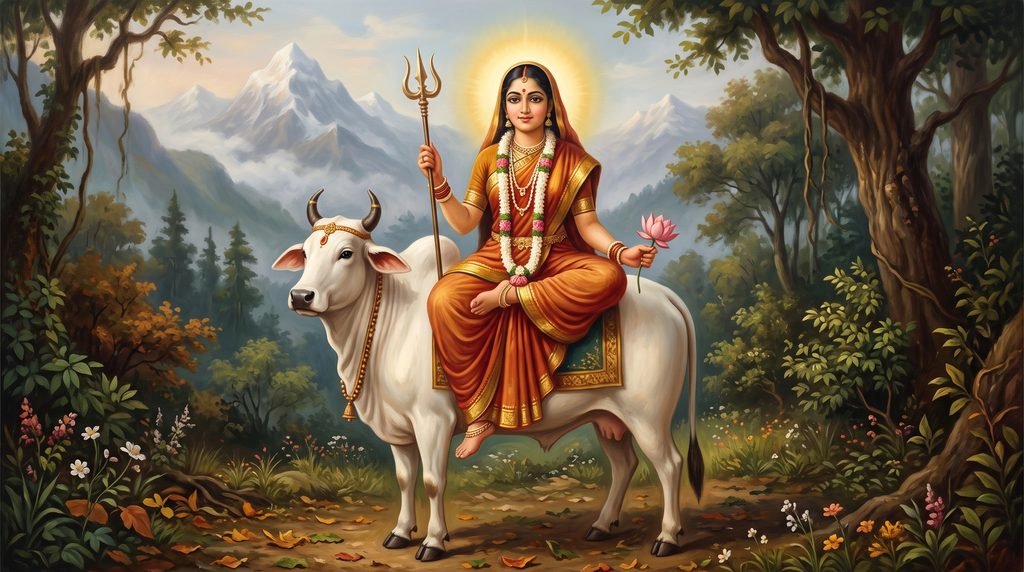
As we transition from the ancestral purifications of Pitru Paksha into the radiant nine nights of Navaratri, our spiritual journey begins with the worship of the Divine Mother in her first manifestation: Sri Devi Shailaputri.
She is the absolute foundation of the Navadurga sadhana. Before we can ascend to the higher spiritual realms of the subsequent days, we must first firmly ground our consciousness in the unshakable, mountainous stability that Shailaputri represents.
The Divine Form and Sacred Puranic History
For those new to Vedic culture, the emergence of Sri Shailaputri is a profound chapter in our sacred Puranic history, rooted in the profound love between the Divine Mother and Lord Shiva.
In Her previous incarnation, the Divine Mother was born as Sati, the daughter of the powerful king Prajapati Daksha. Sati married Lord Shiva against her father’s wishes, as Daksha misunderstood Shiva’s ascetic nature. In his arrogance, Daksha organized a grand Yajna (a massive fire sacrifice) and invited all the gods and celestial beings, intentionally excluding Lord Shiva to humiliate Him.
Drawn by her familial bond, Sati attended the sacrifice uninvited, hoping to change her father’s heart. Instead, she was met with public insult and derision directed at her husband. Unable to bear the disrespect shown to the Supreme Lord, and realizing her physical body was tainted by her father’s arrogance, Sati invoked her inner yogic fire and gave up her life right there in the sacrificial arena.
Consumed by cosmic grief, Lord Shiva destroyed the sacrifice, took Sati’s lifeless body, and eventually withdrew from the universe entirely, entering a state of absolute, impenetrable meditation. Without the Divine Mother, the universe lost its nurturing energy and balance.
To restore cosmic order and reunite with Shiva, the Divine Mother promised to be born again. This time, She chose a lineage of unshakeable nobility and strength: She was born to Lord Himavan, the King of the Himalayas, and Queen Mainavati.
Because she took birth as the daughter (Putri) of the mountain (Shaila), she became known as Shailaputri. In this majestic form, She is depicted riding Nandi, the sacred white bull. She holds a Trishula (trident) in Her right hand, symbolizing mastery over the three gunas, and a lotus blossom in Her left, representing blossoming consciousness. Having the mountain as Her father gave Her the absolute, steadfast resolve needed to eventually awaken Lord Shiva from His deep meditation—a journey we will explore further on Day 2.
Esoteric and Spiritual Significance
In the esoteric traditions of yoga and Tantra, the nine forms of Durga correspond directly to the awakening of the spiritual energy (Kundalini) within the subtle body.
Sri Shailaputri governs the Muladhara Chakra (the Root Chakra) located at the base of the spine. Just as a towering mountain provides an unshakable foundation for the earth, Shailaputri provides the foundational grounding required for any serious spiritual practice. When a seeker invokes Her on the first day of Navaratri, they are asking for Her adamantine strength and single-pointed focus. Without this “mountain-like” resolve, the mind wavers and the spiritual energy cannot safely ascend to the higher chakras.
She teaches us that true spiritual ascent begins with absolute grounding, unwavering discipline, and pure devotion.
Today’s Sadhana and Meditation
For your daily practice, please follow these guidelines carefully to harmonize your physical and subtle bodies for the reception of Her grace:
- Seat: Sit on a woolen mat in a quiet place. If sitting on a chair, ensure a woolen mat is placed beneath your feet to insulate and preserve your spiritual energy.
- Direction and Posture: Face East or North. Maintain a comfortable position with your spine kept perfectly straight.
- Centering: Chant OM nine times to balance the energy centers in your body. Follow this with deep, mindful breathing for 3 to 5 minutes to settle the mind.
- Visualization: Close your eyes and visualize the Divine Mother Durga at your Ajna Chakra (the space between the eyebrows). Mentally worship Her by offering fragrant flowers while chanting.
- Mantra Japa: Chant the following specific mantra for Day 1 either 108 times (one full mala) or continuously for 15 to 30 minutes:
Oṃ Aiṃ Hrīṃ Klīṃ Śrīṃ Śailaputrī Durgāyai Namaḥ Oṃ Hrīṃ Duṃ Durgāyai Namaḥ ॐ ऐं ह्रीं क्लीं श्रीं शैलपुत्री दुर्गायै नमः ॐ ह्रीं दुं दुर्गायै नमः
May the Daughter of the Himalayas bless you with unwavering resolve on the first step of this sacred journey.